
Making compost tea
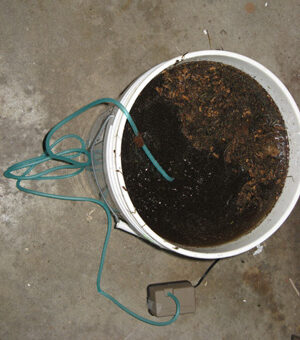
Just like most things with organic gardening, there’s a million ways and recipes to do plant teas. From the simple decision of aerated vs non aerated, to fermenting your leftover greens, you could replace an entire synthetic routine with teas.
We will start with two very simple recipes that can be used as a foliar spray or feeding the plants directly.
Non-aerated tea
1) De-chlorinate your water by leaving it out overnight.
2) Put around 2 cups of compost, soil, or worm castings per 5 gallons of water.
3) Vigorously stir for about 2 minutes.
4) Stir once or twice a day for 5 to 10 days.
Optional to strain or dilute before applying.
Can be diluted up to 1:10
Aerated tea
1) Set up your aerator. The more air, the better.
2) De-chlorinate your water by leaving it out overnight.
3) Put around 2 cups of compost per 5 gallons of water.
Optional: Add half a cup per 5 gallons of unsulphured molasses and stir to make sure it breaks down.
4) Let it brew for 24-48 hours.
Optional: to strain or dilute before applying.
Can be diluted up to 1:10
I usually dilute by 2x for watering the roots, and 5x for foliar spraying.
More Teas
Now if you’re noticing certain deficiencies, or even just want to give your plants a boost, you can mix in organic amendments with the compost. Kelp and alfalfa meals are some of my favorites, full of nitrogen and plenty of micro nutrients, but most organic amendments are usable for teas and have their nutrient values on the package to help give you an idea of what’s in your tea.
You can also make teas out of fresh plants (from dandelion to stinging nettle the list is endless) but here are some examples:
Comfrey– Major source of NPK as well as other micronutrients and minerals.
Stinging Nettle – A great balanced source of NPK, large amounts of Calcium, minerals and micronutrients.
Chamomile – Full of minerals and other plant stimulating compounds, chamomile teas can boost the plants own immunity to disease or pests, and help balance and regulate plant growth.
Valerian – Source of minerals, phosphorus.
Dandelion – NPK, minerals, immune boosting properties.
Yarrow – Contains potassium, selenium, sulfur.
White Oak Bark – Combats disease.
Banana peels – Strong potassium boost.
Grass clippings – Strong nitrogen boost.
Lamb’s quarter – NPK, calcium, manganese.
Sow thistle – Magnesium, phosphorus, copper.
Tansy – Phosphorus.
Chickweed – Potassium, phosphorus, manganese.
Borage – Nitrogen, potassium, micronutrients.
For fresh plants and amendments, you follow the same basic instructions as the compost tea.
Quote below
“Very simply stated Compost Tea is a water-based environment wherein beneficial microorganisms are extracted from compost or vermicompost (worm compost) and multiplied by the millions and billions. Some form of agitation breaks the microbes free from the compost and they multiply because food, like black strap molasses, fish hydrolysate, kelp meal, etc. has been added to the water, which at least one type of microbe digests. When one or more type of microbe begins to multiply in response to the food, other microbes respond to this growth and begin to consume these initial micro bes and multiply in turn and so on and so on. For example the initial microbes are usually bacteria which are food for protozoa so the protozoa multiply in response to the bacteria. The end result is a functional feeding cycle or microbial nutrient cycle. I refer to this as a functional microbial consortia. This develops over a period of 12 to 72 hours or more and is then applied to the soil and plants. In the soil there are a number of organisms which function in basically the same nutrient cycle and zone. Once again, simply stated, there are substances released from the roots of plants which feed bacteria (& archaea), again the bacteria/archaea become prey to the protozoa and the protozoa excrete substances which are available to the roots as nutrients (e.g. nitrogen) thus creating a feeding cycle. Other compost/soil microorganisms of great importance are fungi. Fungal hyphae, are long branching strands which grow through the soil and serve to; bind soil aggregates together, help retain moisture, store certain nutrients, provide a source of food to certain other microbes, provide pathways for nutrient and moisture delivery, decompose organic material and displace disease causing fungi. There are also other types of fungi which do not grow (to my knowledge) in compost or Compost Tea which form a direct symbiotic nutrient exchange relationship with roots. This sort of fungi is called mycorrhizal fungi and there are many different species. The major microorganisms at work in Compost Tea are bacteria, protozoa (flagellates, ciliates and amoebae) and fungal hyphae if present in your compost. It is best to have a wide diversity of each of these microbes present. There are higher order organisms like nematodes found in compost and soil and occasionally these are extracted into Compost Tea but they do not grow nor multiply in the tea. Of course in the soil there are many other contributors to the nutrient cycle, like insects, earthworms and other animals. In its totality this is often referred to as the soil food web.”
– Tim Wilson www.MicrobeOrganics.com

Leave a Reply